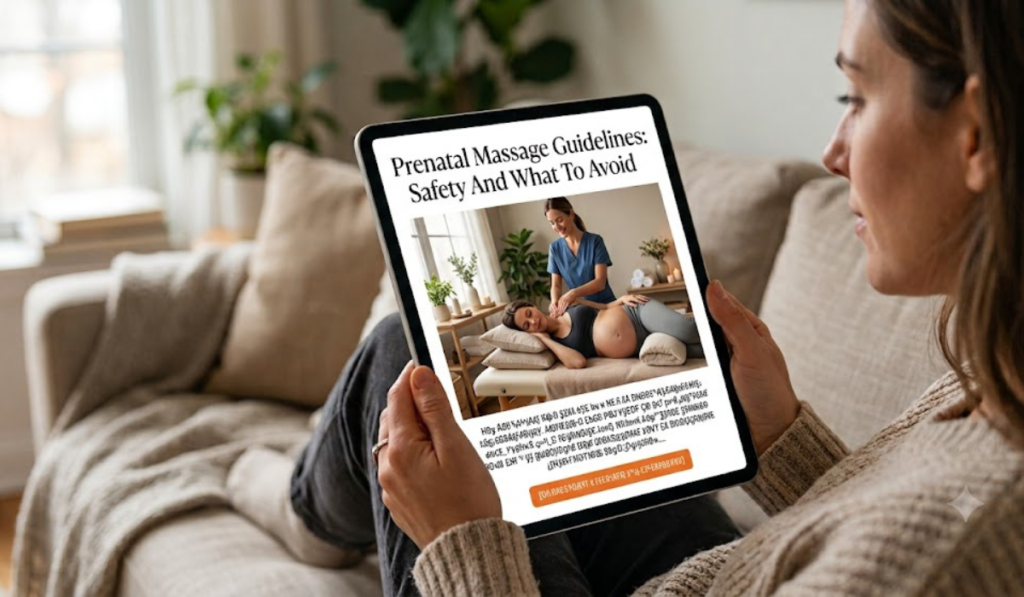
Most Empire Plan members hear about the massage benefit from a colleague, not from their benefits book. A teacher mentions it in a staff room, someone repeats it to a spouse, and by the time it reaches you the details have been mangled — usually into “insurance pays for massages,” which is not what the Plan says at all.
The benefit exists. It is also narrow, and the difference between a paid claim and a denied one is usually decided before you ever lie down on the table. Below is what the published Plan rules say, what has to be in your file first, where the acupuncture rule quietly does you a favor, and what the Plan will not pay for at all.
Who NYSHIP actually covers
NYSHIP is the New York State Health Insurance Program. It covers New York State employees and retirees, staff at participating agencies and participating employers, and their enrolled dependents. Teachers, police officers, municipal workers, SUNY staff and retired state employees are commonly enrolled through it.
The Empire Plan is one option within NYSHIP, and it is the one these rules describe. If you are enrolled in an HMO through NYSHIP instead, your massage and acupuncture benefits are set by that HMO and will not match what follows. The front of your benefit card tells you which you have. If you are not sure, your Health Benefits Administrator — usually in your personnel office, or your former agency’s personnel office if you have retired — can confirm it.
One more split worth knowing: benefit details can differ between State-agency enrollees and participating-agency enrollees, and they can change from one plan year to the next. Treat everything on this page as a starting point for the call you make to the Plan, not as a substitute for it.
What the Empire Plan covers

Massage therapy sits under the Basic Medical Program. Since July 1, 2023, the Plan allows a maximum of 20 visits per calendar year, and those visits are subject to the annual deductible and 20 percent coinsurance. Massage given by a network physician or provider counts toward that same 20. Visits to a network Managed Physical Medicine provider — the chiropractic, physical therapy and occupational therapy network — generally do not count against it.
Two words carry the weight there: Basic Medical. That is the part of the Plan built around deductible-and-coinsurance care rather than a flat copayment, which is why the cost of a covered massage visit depends on how far into your deductible you already are.
The acupuncture rule most members miss
20 visits per calendar year
Massage therapy
Basic Medical Program. Annual deductible plus 20 percent coinsurance applies. Network physician or provider visits count toward the same 20.
No annual visit limit
Acupuncture · participating provider
Subject to a single copayment per visit. This benefit did not change in the July 2023 update.
Documented medical need
What triggers coverage
A referring provider has to have recorded the diagnosis and why hands-on treatment is indicated.
20 visits per calendar year
Acupuncture · nonparticipating provider
Deductible and 20 percent coinsurance apply, the same structure as massage.
If you are managing ongoing pain and you are weighing which benefit to spend first, that difference matters. Twenty massage visits is a finite pool for the year. Acupuncture with a participating provider is not capped the same way, and it does not carry the same documentation hurdle before the first visit.
Some patients use both, where their provider recommends it. The point is simply to spend a capped benefit where it does the most good rather than burning through it by March, and to know which of the two rules applies before you book. Your provider’s recommendation still leads; the benefit structure is a practical consideration alongside it, not a reason to choose one treatment over another.
Medical massage, not the spa kind
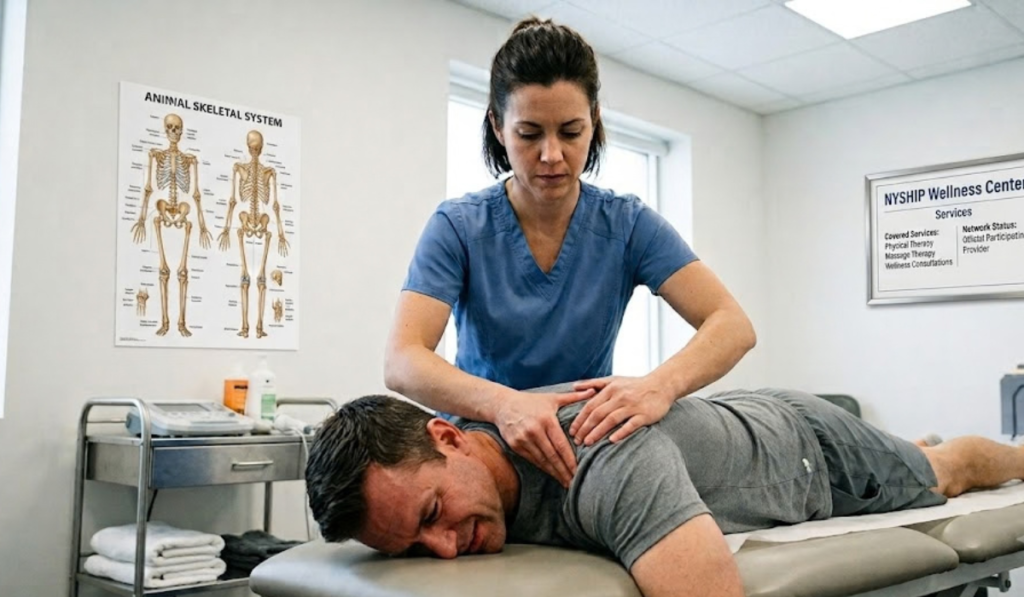
A covered massage visit looks different from a gift-certificate booking, and the difference is mostly paperwork. The Plan pays for treatment of a condition. That means a licensed New York State massage therapist working a documented problem — the same back, neck or shoulder issue your referring provider wrote down — and a record that says what was treated and why.
What that looks like in practice:
- A diagnosis from your physician, nurse practitioner or other qualified provider, in writing.
- A therapist licensed in New York State, with the license number on your receipt.
- An itemized receipt showing the date, the service code and the amount charged.
- Treatment notes that tie the session back to the condition being managed.
A relaxation massage with no documentation behind it is a lovely hour. It is not a claim.
The distinction is not about how hard the work is or how nice the room smells. It is about whether there is a clinical record behind the visit. Two people can receive an hour of similar hands-on work; the one with a diagnosis, a referring provider’s note and treatment records has something the Plan can review, and the other does not.
Worth saying plainly, because members ask: a massage therapist licensed in New York State does not diagnose conditions and does not prescribe treatment. That part belongs to your physician or nurse practitioner. The therapist works within what your provider has documented, and adds their own notes on what was treated and how you responded.
Before your first visit
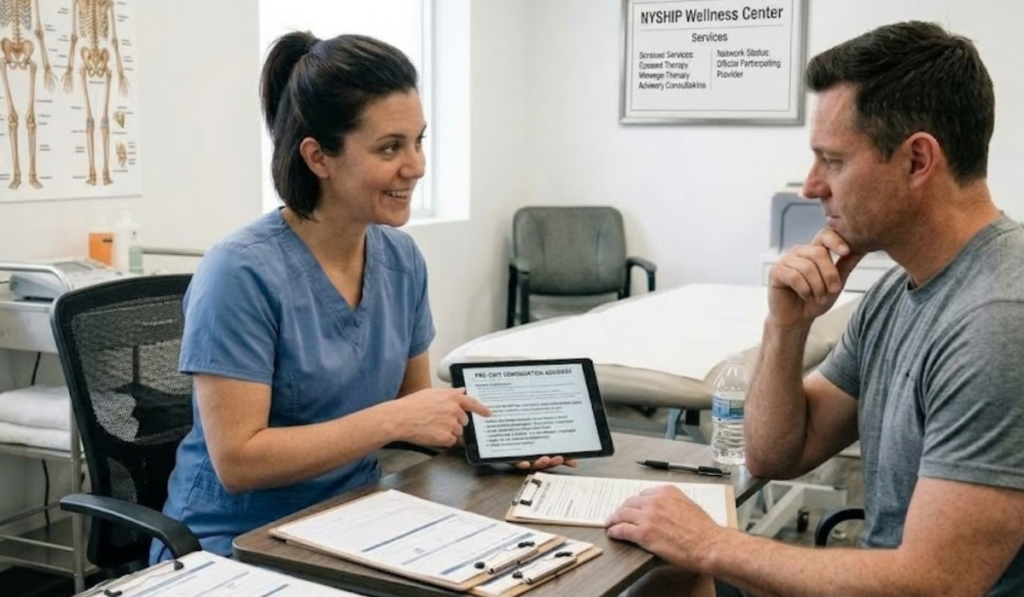
Get it in writing
Ask your provider to note the diagnosis and the recommendation for massage therapy. A line in your visit summary or patient portal note is usually enough to start with — what matters is that it names the condition.
Find out where your deductible stands
Call The Empire Plan at 1-877-769-7447 and press or say 1 for the Medical/Surgical Program, administered by UnitedHealthcare. Ask what remains on your annual deductible and how many of your 20 massage visits have been used this calendar year.
Ask whether the provider participates
This single answer changes your out-of-pocket cost more than anything else on this page. Ask before you book, not after.
Request a predetermination if you want certainty
For Medical/Surgical services, your provider can complete an Empire Plan Predetermination Form so you know what the Plan will allow before you start care.
Keep every receipt
Itemized, with the therapist’s license number and the service code. If you are filing for reimbursement, that receipt is the claim.
Network or not, and why the bill changes
Since July 1, 2023, the Plan bases out-of-network reimbursement on 275 percent of Medicare rates published by CMS, rather than the older FAIR Health method. You still owe your deductible and coinsurance. On top of that, a nonparticipating provider can bill you the difference between what they charge and what the Plan allows — balance billing — and that amount is on you.
So “covered” and “free” are different words. Ask two questions before your first appointment: is this provider participating, and what will I owe if they are not.
What the Plan will not pay for
Knowing the limits ahead of time is cheaper than finding them on an Explanation of Benefits. Under the published Plan rules, expect problems when:
- The visit is for relaxation or general wellness with no diagnosis behind it.
- You have already used your 20 massage visits for the calendar year. The count resets in January, not on your enrollment anniversary.
- The documentation is thin — no diagnosis named, no itemized receipt, no license number.
- You have not met your annual deductible yet, in which case the visit is covered in principle and still paid by you in practice until the deductible is satisfied.
- The provider does not participate and bills above what the Plan allows. That balance is yours.
There is also a category worth naming separately. The Empire Plan has at times offered discount arrangements with complementary-care networks, and a discount is not coverage. If someone tells you a service is “covered” because there is a member discount attached to it, ask whether the Plan reimburses the claim or simply reduces the fee you pay out of pocket. Those are different things.
If a claim comes back denied

A denial is not the end of the process, and it is not usually a judgment about whether you need care. Most denials we hear about trace back to missing paperwork rather than a decision that massage therapy was inappropriate.
Get the reason in writing
Your Explanation of Benefits states why the claim was processed the way it was, and who to contact about it. Read that before making any calls.
Check the obvious causes first
A missing diagnosis code, a receipt without the therapist’s license number, a visit that fell past the 20-visit limit, or a deductible that had not been met yet.
Go back to your referring provider
If the medical necessity documentation was the gap, they are the one who can supply it.
Ask about the appeal process
The Plan will tell you the deadline and what supporting documentation it wants. Deadlines are real, so start early rather than at the end of the window.
We can tell you what documentation we hold for your visits and supply copies of your records. We cannot overturn a coverage decision — that sits with the Plan and its administrator.
What medical massage is used for
Referrals we see most often at our Melville office involve:
- Chronic low back and neck pain, including pain that keeps returning after it settles
- Muscle spasm and guarding after an injury
- Recovery from a strain, sprain or surgical procedure, alongside other care
- Limited range of motion in a shoulder or hip
- Tension headaches connected to neck and upper-back tightness
- Myofascial pain and trigger points that have not responded to stretching alone
These are the reasons providers write on referrals. They are not promises about what massage therapy will do for you. Results vary from person to person, massage is generally used alongside other care rather than instead of it, and some conditions call for a different treatment entirely. Whether massage therapy is appropriate for you is a clinical decision your provider makes, and we work from what they document.
If your pain is new, severe, or came on with numbness, weakness or loss of function, see your provider before booking any hands-on care.
How it works at Circle Wellness

We see Empire Plan members regularly, and the first conversation is usually about paperwork rather than muscles. Our front desk will walk you through the questions to ask the Plan, tell you which documents we need on file, and flag anything that looks likely to cause trouble later. We do not decide what your plan covers and we cannot quote you a reimbursement amount. The Plan holds your benefit information and makes the determination.
A first visit runs longer than a routine one. Your therapist reads the referral, asks about how the pain behaves through the day, and works the specific area rather than a standard full-body routine. Everything is recorded for your file, which is what keeps the next claim clean.
Circle Wellness MD is at Melville Corporate Plaza, 25 Melville Park Road, Suite 200 B, Melville, NY. We are open 10am to 7pm and we serve patients across Long Island, including Huntington, Plainview and much of Suffolk County.
FAQs

Can I get a massage in the first trimester?
The American Pregnancy Association says massage can begin at any point in pregnancy. Many practices prefer to wait until after 12 weeks as a precaution. If you want treatment earlier, ask your provider for clearance.
Is foot massage safe during pregnancy?
Generally yes, with a therapist trained in prenatal work who knows which points around the ankle to avoid. Deep pressure on the calves is avoided because of clot risk.
What position will I be in?
Side-lying with pillow support, most likely. Lying flat on the back is avoided from around 20 weeks, and face-down positioning is not used.
Where should you not massage a pregnant woman?
The abdomen, deep pressure on the legs, specific acupressure points at the ankles and in the web of the hand, areas with varicose veins, and any area with unexplained swelling, redness or warmth.
Can prenatal massage bring on labour?
There is limited evidence that ordinary massage induces labour. Certain points are avoided as a precaution rather than because an effect is established.
How often can I have prenatal massage?
There is no standard schedule. It depends on your symptoms, your pregnancy, and what your provider advises.
Is deep tissue massage safe in pregnancy?
Deep pressure is avoided, particularly on the legs. Prenatal work uses lighter to moderate pressure, and the American Pregnancy Association describes Swedish technique as the recommended approach.
Do I need a doctor's note?
Not usually for a straightforward pregnancy after 12 weeks. You do if you want treatment in the first trimester at most practices, or if your pregnancy has any complicating factor.
Can I use insurance for prenatal massage?
Possibly, when it is documented as medical massage and your plan covers massage therapy. Circle Wellness currently bills NYSHIP directly; other plans are self-pay. Our NYSHIP guide covers the Empire Plan rules.
What about massage after the birth?
Postnatal massage is common once you have been cleared at your postpartum check. Timing depends on the birth and your recovery, so ask your provider.
Ask us before you book

Check your NYSHIP benefits before you book
We will point you at the right question to ask and who to ask it of, before you book anything. Please keep medical details off the web form — call and we will take it from there.