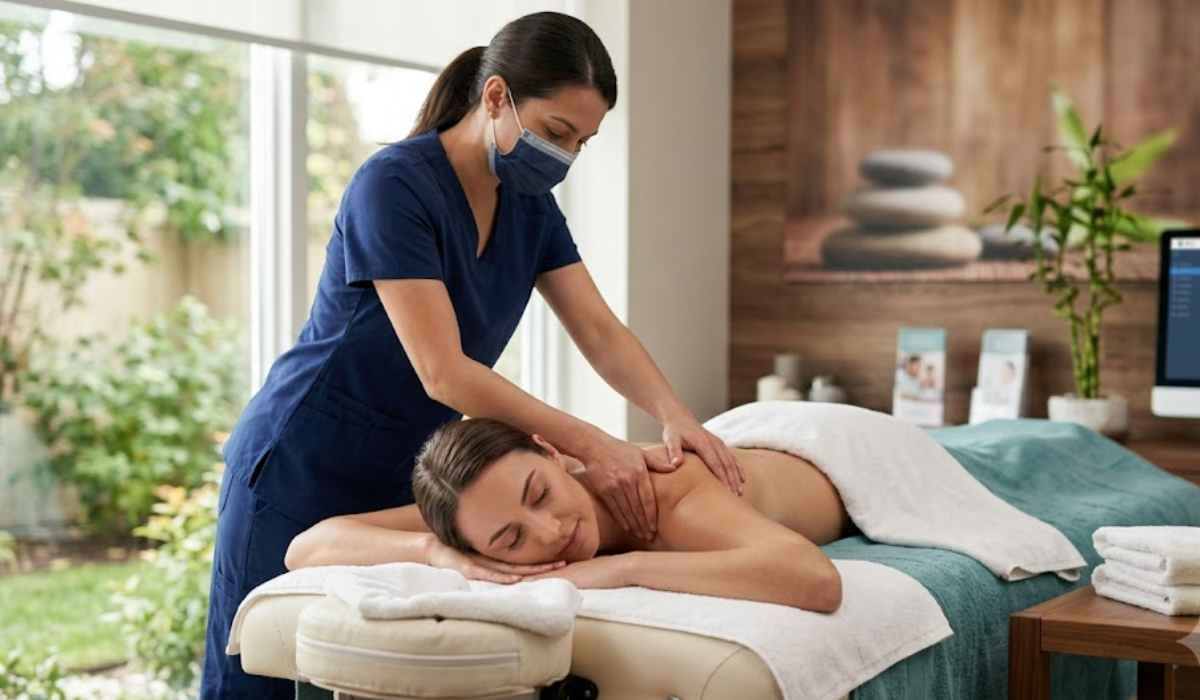
Massage with Insurance: Does Blue Cross Blue Shield Cover It?

Does Blue Cross Blue Shield Cover Massage Therapy?

The most accurate answer is:

Some Blue Cross Blue Shield plans may cover medically necessary massage therapy, but many plans exclude it or restrict which providers can perform it.

Blue Cross Blue Shield is not one national insurance plan.

The Blue Cross Blue Shield Association licenses the BCBS name to independent, community-based insurance companies. Each company offers multiple plans, and employers may customize or self-fund their benefits.

This means two people carrying Blue Cross Blue Shield cards can have completely different massage-therapy benefits.

One plan may:

  • Exclude massage therapy completely
  • Cover it only when performed by a physical therapist
  • Cover manual therapy but not massage billed by a licensed massage therapist
  • Cover a limited number of visits
  • Require a referral
  • Require prior authorization
  • Offer out-of-network reimbursement
  • Apply the entire cost to the deductible

Another BCBS plan may have none of those benefits.

The plan document—not a general website article—controls the member’s coverage.

Why There Is No Universal BCBS Answer

BCBS coverage can vary according to:

  • The state where the plan is issued
  • The local BCBS company
  • The employer or organization sponsoring the plan
  • Whether the employer funds its own claims
  • PPO, HMO, EPO, POS, or indemnity structure
  • Whether the member has individual, employer, federal employee, Medicare, or Medicaid coverage
  • The plan year
  • Network status
  • Provider type
  • Medical necessity
  • The service being billed

Blue Cross and Blue Shield of Illinois, for example, explains that its medical policies serve only as guidelines and that the member’s benefit plan documents ultimately control coverage. It also notes that self-funded employer plans may use different rules.

Important distinction

A medical policy may discuss a treatment without making it a covered benefit.

A benefit booklet may cover a category such as outpatient therapy without covering massage performed by every provider type.

A representative may confirm that a benefit exists without guaranteeing that a future claim will be approved.

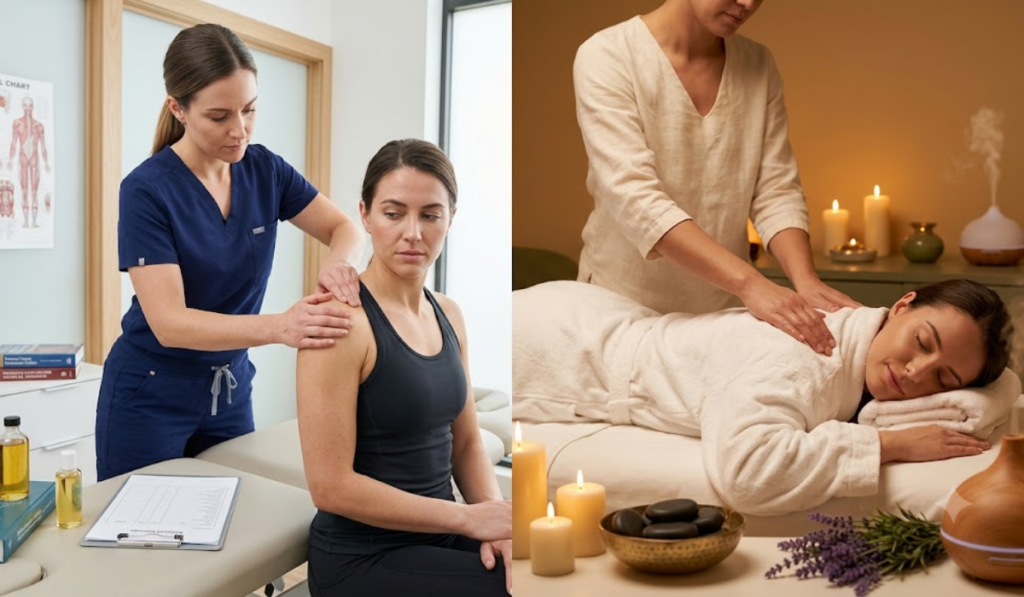
Medical Massage Vs Relaxation Massage

Insurance plans are more likely to consider massage when it is connected to a documented medical problem.

Medical massage focuses on a specific symptom, diagnosis, injury, or functional limitation.

It may involve:

  • Review of medical history
  • Identification of the affected area
  • Defined treatment goals
  • A provider order or prescription
  • Clinical documentation
  • Progress assessment
  • Coordination with other treatment
  • Submission of a medical claim
  • Reducing soft-tissue restriction
  • Improving comfortable range of motion
  • Addressing muscle tension associated with a diagnosed condition
  • Supporting rehabilitation after an eligible injury
  • Managing symptoms as part of a broader medical plan

Relaxation massage is generally chosen for:

  • General stress relief
  • Personal wellness
  • Comfort
  • Recreation
  • Pampering
  • Temporary relaxation

These are valid reasons to receive massage, but they generally do not establish medical necessity for insurance purposes.

The IRS uses a similar distinction for qualified medical expenses: the expense must primarily diagnose, treat, mitigate, cure, or prevent an illness or affect a body structure or function. Expenses that are merely beneficial to general health do not automatically qualify.

Learn more about the difference between clinical and relaxation services in Circle Wellness’s guide to medical massage in Melville.

What Determines Whether BCBS Covers Massage?

The first question is not whether massage might help.

The first insurance question is:

Does my benefit contract include massage therapy performed by this provider type?

Some plans expressly exclude massage therapy.

Others may cover related services only when performed by:

  • A physical therapist
  • Occupational therapist
  • Chiropractor
  • Physician
  • Another recognized provider

A New York-licensed massage therapist may be legally qualified to practice massage without automatically being eligible for reimbursement under every BCBS plan.

The plan may require documentation showing that massage is treating a diagnosed condition rather than providing general wellness.

The insurer may review:

  • Diagnosis
  • Symptoms
  • Functional limitations
  • Duration of the problem
  • Previous treatment
  • Treatment goals
  • Frequency
  • Progress
  • Reason continued treatment is necessary

“Medical necessity” is defined by the plan and does not guarantee payment by itself.

The therapist may need to be:

  • Licensed in the state
  • Registered and in good standing
  • Enrolled or credentialed with the plan
  • Eligible to bill the applicable service
  • Working within a recognized medical setting
  • Supervised or referred by another provider when required

New York requires anyone practicing or advertising massage therapy to be properly licensed or otherwise authorized. New York licensure requires qualifying education, examination, and CPR training.

Licensure establishes legal professional eligibility. It does not force an insurance company to cover the therapist’s services.

An in-network provider has a contract with the plan.

This commonly means:

  • Negotiated rates
  • Lower cost-sharing
  • Direct claim submission
  • Fewer reimbursement steps
  • Less risk of balance billing

An out-of-network provider does not have that contract.

Out-of-network care may involve:

  • A separate deductible
  • Higher coinsurance
  • Lower reimbursement
  • Patient-submitted claims
  • Balance billing
  • No coverage under network-only plans


Some plans require:

  • A physician’s prescription
  • Referral from a primary care provider
  • Treatment order
  • Letter of medical necessity
  • Prior authorization
  • Predetermination

Other plans do not.

A prescription helps document the medical purpose of treatment, but it does not override an exclusion in the plan.

A plan may limit visits:

  • Per year
  • Per diagnosis
  • Per episode of care
  • Per body region
  • Across all providers
  • Combined with physical therapy, occupational therapy, chiropractic, or other manual treatment

Ask whether previous visits with another provider count toward the same limit.

Coverage may depend on proper submission of:

  • Procedure code
  • Diagnosis code
  • Rendering-provider information
  • Provider license or identifier
  • Date of service
  • Treatment notes
  • Prescription
  • Proof of payment
  • Claim form
  • Prior-authorization number

A valid code does not prove that the benefit is covered.

BCBS plans repeatedly state that medical policies, eligibility checks, prior authorization, and predetermination do not guarantee payment. The actual claim is still processed under the member’s plan terms.

Quick BCBS Coverage Comparison

Situation Likelihood of coverage Important limitation
Massage solely for relaxation Usually low General wellness is commonly excluded
Medical massage for a diagnosed condition Possible Plan must cover the service and provider
Massage prescribed by a physician Possible Prescription does not override exclusions
Massage performed by an in-network eligible provider More favorable Medical necessity and cost-sharing still apply
Massage performed by an out-of-network LMT Depends on plan PPO benefits, deductible, and provider eligibility matter
Massage under an HMO or EPO Often limited Out-of-network care may not be covered
Manual therapy during covered physical therapy May be covered The benefit may apply to PT—not independent massage therapy
Prenatal massage Plan-specific Routine comfort massage may not meet medical-necessity rules
Massage after an injury Possible Diagnosis, authorization, and other coverage sources may apply
Massage for general stress Usually not covered A diagnosed condition and eligible treatment plan may be required
Massage with a BCBS Medicare plan Plan-specific Original Medicare excludes massage
Self-pay massage Available regardless of insurance Patient pays directly

How to Identify Your Blue Cross Blue Shield Plan

Look at your member ID card.

Important details may include:

  • Local BCBS company name
  • Plan name
  • PPO, HMO, or EPO
  • Group number
  • Member ID
  • Three-letter identification prefix
  • Customer-service number
  • Claims address
  • Network name

BCBS provides a “Find My Local Plan” tool that uses the first three letters of the member ID or the member’s ZIP code to identify the correct local company.

Always call the number on the back of your own card for benefit questions.

A general BCBS number, provider, or internet article may not have access to the terms of your specific employer plan.

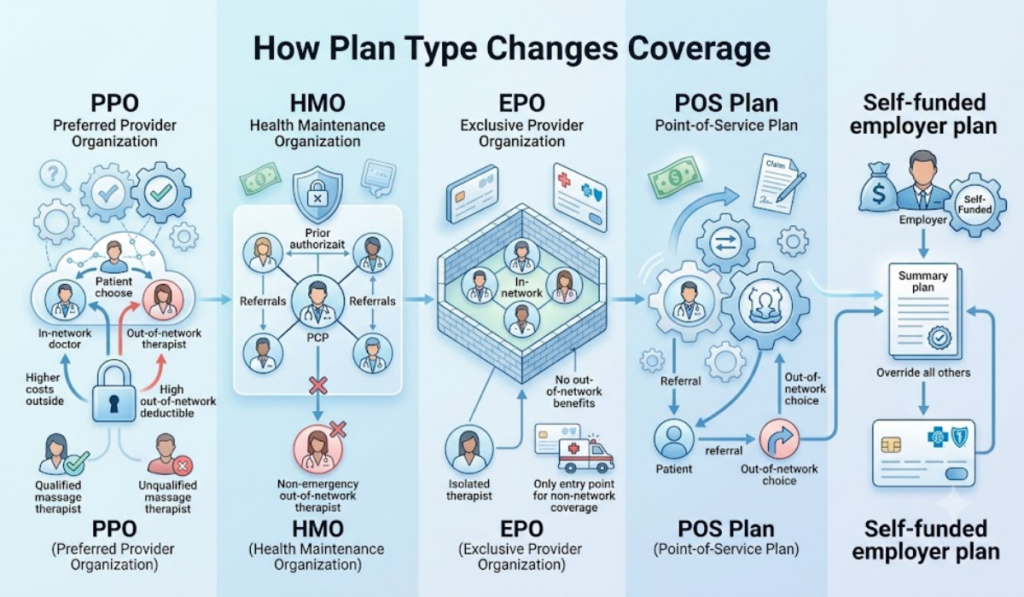
How Plan Type Changes Coverage

A PPO commonly offers:

  • In-network benefits
  • Some out-of-network benefits
  • Greater provider flexibility
  • Higher costs outside the network
  • Separate out-of-network deductible

A PPO does not automatically cover massage therapy.

The service and provider must still qualify.

An HMO generally requires:

  • Network providers
  • Coordination through a primary care provider
  • Referrals for certain services
  • Prior authorization for selected care

Non-emergency out-of-network massage is often not covered.

An EPO generally uses a defined network and may provide no out-of-network benefit except emergencies.

A superbill from an out-of-network therapist may therefore produce no reimbursement.

A point-of-service plan may combine features of an HMO and PPO.

Referral requirements and out-of-network benefits depend on the contract.

A self-funded employer pays employee medical claims while an insurance company may administer the plan.

The employer can define benefits that differ from the insurer’s standard fully insured products.

The BCBS logo may appear on the card even though the employer’s Summary Plan Description controls the massage benefit.

In-Network Versus Out-of-Network Massage

Example

Suppose the therapist charges $150.

The plan’s out-of-network allowed amount may be $80.

If the plan pays 60% after the deductible:

  • Allowed amount: $80
  • Plan payment: $48
  • Your coinsurance: $32
  • Possible amount above the allowance: $70

Your total responsibility could be $102, even though the plan technically “covered” the service.

Coverage does not always mean the session is free or inexpensive.

Do You Need a Prescription or Referral?

Possibly.

A prescription or referral may help show that the service is part of medical treatment.

It may need to include:

  • Patient’s name
  • Diagnosis
  • Body area
  • Treatment requested
  • Frequency
  • Duration
  • Provider’s name
  • Credentials
  • Signature
  • Date

Before obtaining a prescription, ask BCBS:

“Does my plan cover massage therapy when it is performed by a New York-licensed massage therapist, and is a prescription required?”

Do not ask only:

“Does my plan cover physical therapy?”

Physical therapy and massage therapy may be treated as different benefits.

What Documentation May Be Required?

The insurer may request:

  • Prescription or referral
  • Letter of medical necessity
  • Clinical treatment plan
  • Progress notes
  • Itemized receipt
  • Diagnosis code
  • Procedure code
  • Provider’s legal name
  • Provider’s license
  • National Provider Identifier, when applicable
  • Tax identification number
  • Dates of service
  • Amount charged
  • Amount paid
  • Completed member claim form
  • Prior-authorization information

What is a superbill?

A superbill is a detailed document that may contain the information required for an out-of-network claim.

It may include:

  • Patient information
  • Provider information
  • Diagnosis
  • Procedure
  • Date
  • Fee
  • Payment information

A superbill is not a reimbursement guarantee.

Before treatment, ask your plan whether it accepts claims from the particular provider type.

How to Verify Your BCBS Massage Benefits

Use:

  • The company name on your card
  • Three-letter prefix
  • Member portal
  • Customer-service number

Request:

  • Summary of Benefits and Coverage
  • Full certificate of coverage
  • Evidence of coverage
  • Summary Plan Description for a self-funded employer plan
  • Relevant exclusions
  • Outpatient-therapy section

Federal law requires individual and job-based health plans to provide a standardized Summary of Benefits and Coverage. However, the short summary may not list every massage exclusion, so the full plan document may still be necessary.

Ask directly:

“Is massage therapy an excluded service under my plan?”

Then ask:

“Does the answer change when massage is medically necessary and performed by a licensed massage therapist?”

Ask:

“Can a New York-licensed massage therapist independently render and bill this service under my plan?”

Do not assume coverage because massage is provided inside a medical office.

Provide the clinic’s and rendering provider’s:

  • Full legal name
  • Address
  • NPI, when applicable
  • Tax ID, when requested
  • License information

Ask about:

  • Prescription
  • Referral
  • Prior authorization
  • Predetermination
  • Medical-necessity review

Ask for:

  • Deductible remaining
  • Copayment
  • Coinsurance
  • Allowed amount
  • Visit limit
  • Visits already used
  • Out-of-network reimbursement
  • Balance-billing exposure

Record:

  • Date and time
  • Representative’s name
  • Call-reference number
  • Questions asked
  • Answers received

Benefit information may help you plan, but it does not guarantee claim payment.

What You May Have to Pay

Deductible

The amount you pay before certain plan benefits begin.

A claim may be covered but applied entirely to the deductible.

Copayment

A fixed amount for a covered service.

Coinsurance

A percentage of the plan’s allowed amount.

Non-covered amount

The full charge for a service excluded by the plan.

Balance bill

The difference between the provider’s charge and the insurer’s allowed amount when balance billing is permitted.

Out-of-network deductible

Many PPO plans have a separate, higher deductible for out-of-network services.

Visit-limit overage

Once the annual visit limit is reached, additional sessions may become self-pay.

Why BCBS Massage Claims Are Denied

Some plans exclude massage regardless of medical necessity.

The plan may cover manual therapy provided by a physical therapist but not massage provided by an independent LMT.

An HMO or EPO may have no non-emergency out-of-network benefit.

The plan may require documentation dated before treatment begins.

The service may require review before treatment.

The documentation may not clearly explain:

  • Diagnosis
  • Functional problem
  • Treatment goal
  • Progress
  • Need for continued care

Treatment received from another provider may count toward the same limit.

This is cost-sharing, not necessarily a denial.

The claim may be missing:

  • Provider information
  • Diagnosis
  • Procedure
  • Prescription
  • Date
  • Signature
  • Proof of payment

The documentation may not support a medical purpose.

Plans have filing deadlines.

An auto accident or work-related injury may need to be submitted to No-Fault or workers’ compensation before ordinary health insurance.

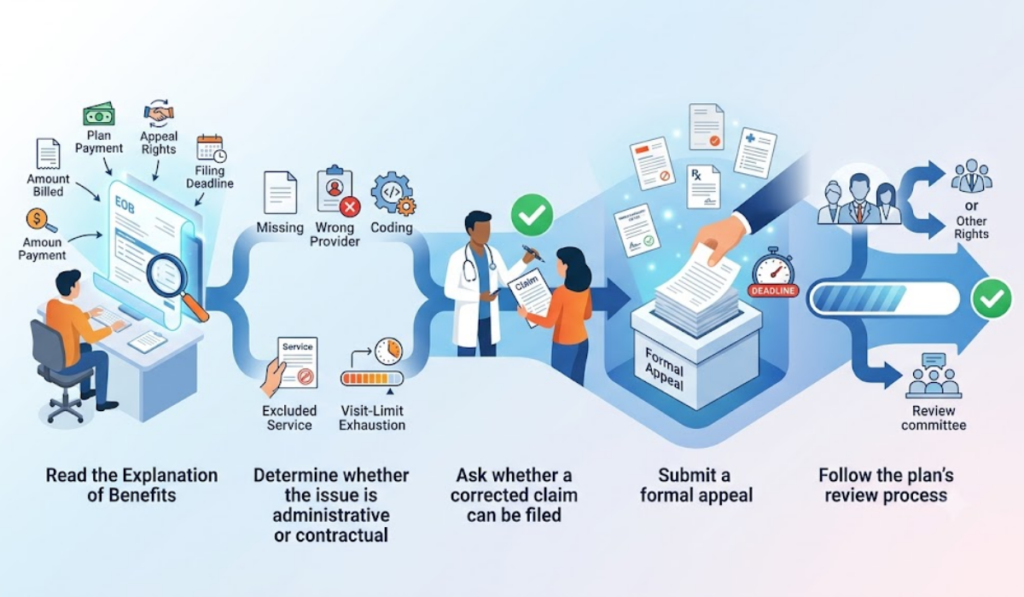
How to Appeal a Denied BCBS Claim

Review:

  • Reason code
  • Amount billed
  • Allowed amount
  • Plan payment
  • Patient responsibility
  • Appeal rights
  • Filing deadline

Administrative issues may include:

  • Missing documentation
  • Wrong provider information
  • Coding error
  • Missing referral
  • Missing authorization

Contractual issues may include:

  • Excluded service
  • Provider-type exclusion
  • No out-of-network benefit
  • Visit-limit exhaustion

The provider may be able to correct missing or inaccurate information.

Possible supporting documents include:

  • Denial notice
  • Prescription
  • Referral
  • Medical-necessity letter
  • Clinical notes
  • Treatment plan
  • Progress measurements
  • Itemized receipt
  • Relevant plan language
  • Provider credentials

Depending on the decision and plan, additional internal or external appeal rights may exist.

Do not miss the appeal deadline stated in the denial notice.

Does Anthem or Another BCBS Company Cover Massage?

There is no accurate universal answer.

Anthem and other BCBS-affiliated companies offer many plans with different:

  • Exclusions
  • Networks
  • Referral rules
  • Provider eligibility standards
  • Employer customizations
  • Out-of-network benefits

It is inaccurate to state:

“Anthem covers massage therapy.”

A safer and more accurate statement is:

“A particular Anthem or BCBS plan may cover medically necessary massage under specific conditions. The member must verify the exact plan.”

What About the Blue Cross Blue Shield Federal Employee Program?

The Blue Cross and Blue Shield Federal Employee Program offers several plans, including FEP Blue Focus, FEP Blue Basic, and FEP Blue Standard.

Each has its own benefit brochure, network rules, cost-sharing, and exclusions. The official FEP website advises members to review the complete current-year brochure rather than relying only on benefit summaries.

Federal employees should:

  1. Identify the exact FEP option.
  2. Review the current official brochure.
  3. Search the brochure for:
    • Massage
    • Manual therapy
    • Physical therapy
    • Alternative treatment
    • Exclusions
  4. Call the local customer-service number on the member card.
  5. Verify whether a licensed massage therapist is an eligible provider.

Do not assume that chiropractic or physical-therapy coverage includes massage performed by an LMT.

What About BCBS Medicare Plans?

Original Medicare

Original Medicare does not cover massage therapy.

Medicare’s official coverage page states that members pay all costs for massage therapy.

Medicare Advantage

Some Blue Cross Blue Shield Medicare Advantage plans may include extra benefits not covered by Original Medicare.

These may include:

  • Wellness allowances
  • Fitness benefits
  • Complementary-care benefits
  • Limited manual-therapy benefits
  • Flex cards

The details vary by plan and year.

Can HSA or FSA Funds Pay for Massage?

Possibly.

HSA and FSA reimbursement generally depends on whether massage is primarily treating a physical or mental condition rather than serving only general health or relaxation.

The IRS explains that qualifying medical expenses must primarily diagnose, cure, mitigate, treat, or prevent disease or affect a body structure or function. General-health expenses do not automatically qualify.

Documentation may include:

  • Prescription
  • Letter of medical necessity
  • Diagnosis
  • Itemized receipt
  • Dates of treatment
  • Provider information

The HSA or FSA administrator makes the final determination.

Ask before using the account for a massage package or recurring wellness sessions.

Does Circle Wellness Accept Blue Cross Blue Shield?

Circle Wellness’s current insurance page states that the clinic directly accepts NYSHIP insurance only.

Circle Wellness does not currently advertise direct participation with standard Blue Cross Blue Shield plans.

Patients with BCBS may consider:

  • Self-pay medical massage
  • HSA or FSA funds when eligible
  • Requesting appropriate visit documentation
  • Asking BCBS whether out-of-network reimbursement is available
  • Using another in-network provider when lower insurance costs are the priority

Do not schedule with the expectation that Circle Wellness will automatically bill or receive payment from BCBS.

Have BCBS but Need Medical Massage?

Circle Wellness provides medical massage through New York-licensed massage therapists in Melville.

Patients with Blue Cross Blue Shield can contact their plan before scheduling to determine whether they have:

  • Out-of-network massage benefits
  • HSA or FSA eligibility
  • Documentation requirements
  • A medical-necessity requirement
  • A deductible
  • A visit limit

Circle Wellness can explain its current self-pay options and tell you what visit documentation may be available.

home 2 svg 4

The BCBS plan

not Circle Wellness—makes the final reimbursement decision.
Circle Wellness currently accepts NYSHIP only for direct insurance billing. BCBS reimbursement is not guaranteed.

If You Have NYSHIP Instead of BCBS

Circle Wellness currently provides direct insurance support for eligible NYSHIP patients.

Its published NYSHIP information states that qualifying members may have medical-massage benefits subject to:

  • Medical necessity
  • Prescription requirements
  • Annual visit limits
  • Deductible or coinsurance
  • Plan verification

Patients with NYSHIP can begin with Circle Wellness’s NYSHIP insurance and benefit-verification page.

Do not confuse NYSHIP Empire Plan coverage with ordinary BCBS coverage. They are separate insurance arrangements with different administrators and rules.

Insurance Red Flags

Be cautious when a clinic or therapist:

  • Guarantees BCBS payment
  • Says every BCBS plan covers massage
  • Says a prescription guarantees reimbursement
  • Claims that using a billing code makes the service covered
  • Bills for a service that was not performed
  • Uses a diagnosis that was not established
  • Uses another provider’s credentials improperly
  • Describes relaxation massage as medically necessary without support
  • Refuses to identify the rendering therapist
  • Cannot verify the therapist’s license
  • Says benefit verification is a payment guarantee
  • Pressures patients to use all visits whether medically needed or not
  • Fails to explain out-of-network costs
  • Promises “free massage” before checking the deductible

FAQs

There is no universal BCBS rule.

Some plans may cover medically necessary massage under specific conditions. Other plans exclude massage or cover similar treatment only when provided by another licensed profession.

Usually not.

Massage received only for relaxation, stress relief, or general wellness is less likely to meet medical-necessity requirements.

Possibly.

Coverage depends on the plan, diagnosis, provider type, network, documentation, referral rules, and exclusions.

No.

A prescription may satisfy one requirement, but the claim may still be denied because:

  • Massage is excluded
  • The therapist is not eligible
  • The provider is out of network
  • Prior authorization was required
  • The visit limit was reached
  • The deductible applies

Some plans may, but others do not recognize an independently billing licensed massage therapist.

Ask specifically about the provider type.

No.

Massage therapy and physical therapy are separately licensed professions with different scopes, training, and insurance rules.

A physical-therapy benefit does not automatically cover massage performed by an LMT.

Some PPO plans may have out-of-network benefits, but the service and provider must still qualify.

A separate deductible, coinsurance, allowed amount, and balance bill may apply.

Usually not, except under limited circumstances defined by the plan.

Verify before treatment.

No.

Requirements vary by plan and service.

Even when authorization is obtained, BCBS plans commonly state that authorization is not a guarantee of claim payment.

Billing depends on the treatment, provider, payer, and documentation.

Do not assume that a commonly used massage or manual-therapy code will be reimbursed when billed by every provider type.

Ask BCBS which service and provider combination is covered.

Possibly, if your plan has out-of-network benefits.

Ask for:

  • Member claim form
  • Filing deadline
  • Required receipt
  • Diagnosis requirements
  • Provider information
  • Claim-submission address or portal

Possibly, when massage primarily treats a diagnosed medical condition.

Massage received only for general health or relaxation may not qualify.

Original Medicare does not cover massage.

A BCBS Medicare Advantage plan may offer supplemental benefits, but the member must verify the exact plan.

Circle Wellness currently states that it accepts NYSHIP only for direct insurance billing.

BCBS patients may use self-pay and ask their plan about possible out-of-network reimbursement.

No provider can guarantee that BCBS will reimburse a claim.

The plan makes the final coverage decision after receiving and reviewing the claim.

Bring:

  • Photo identification
  • Medication list
  • Relevant medical history
  • Prescription or referral, when applicable
  • Information about the condition being addressed
  • A payment method
  • Any documentation requested by the clinic

No.

A superbill contains information that may support a claim. The patient or provider must still submit it according to the plan’s rules.

Yes.

Eligibility and benefit verification are not payment guarantees. The final decision depends on the member’s coverage and claim details on the date of service.

Massage That Meets Insurance Standards

Massage therapy isn’t just wellness—it’s clinical care. If you’re living with pain, tension, or injury, BCBS may help cover your treatment.

Circle Wellness MD helps you:
– Get proper referrals
– Provide insurance-ready documentation
– Maximize your BCBS benefits

Get care that’s covered—book your medical massage today.

Legal Disclaimer

The information provided on this blog and website is for informational and educational purposes only and is not intended as a substitute for professional medical advice, diagnosis, or treatment. Always seek the guidance of your physician or another qualified health provider with any questions you may have regarding a medical condition, diagnosis, or treatment plan. Do not disregard or delay professional medical advice because of information you have read on this website.

The content presented may include discussions of wellness therapies, dietary supplements, compounded medications, and other integrative or alternative treatments that are not evaluated or approved by the U.S. Food and Drug Administration (FDA). These services and products are not intended to diagnose, treat, cure, or prevent any disease.

The content is provided “as is,“ without warranties of any kind, either express or implied. While we strive to ensure accuracy, we make no guarantees regarding the completeness, timeliness, or accuracy of the information presented. The website and its authors disclaim any liability for errors, omissions, or outcomes related to the use of the information provided.

Reference to any specific tests, products, procedures, healthcare professionals, or opinions is not an endorsement or recommendation unless explicitly stated. Links to external websites are provided for convenience and do not constitute an endorsement or guarantee of the content contained therein.

Your use of this website constitutes your acceptance of this disclaimer and any future modifications. If you do not agree, please do not use the site.

This disclaimer shall be governed by and construed in accordance with the laws of the State of New York, without regard to conflict of law principles

Leave a Reply

Your email address will not be published. Required fields are marked *