Where NOT to Massage During Pregnancy: A Therapist’s Guide

There is no single map of body parts that must never be touched during pregnancy.

The most important safety decisions depend on the pregnant person’s symptoms, medical history, stage of pregnancy, positioning, pressure, and the therapist’s training.

A prenatal massage therapist should not apply massage over a leg or arm with possible blood-clot symptoms, an infected or injured area, unexplained severe pain, or an area restricted by the patient’s obstetric provider. Deep abdominal work, painful pressure, prolonged flat-on-the-back positioning later in pregnancy, and techniques intended to stimulate labor also require particular caution.

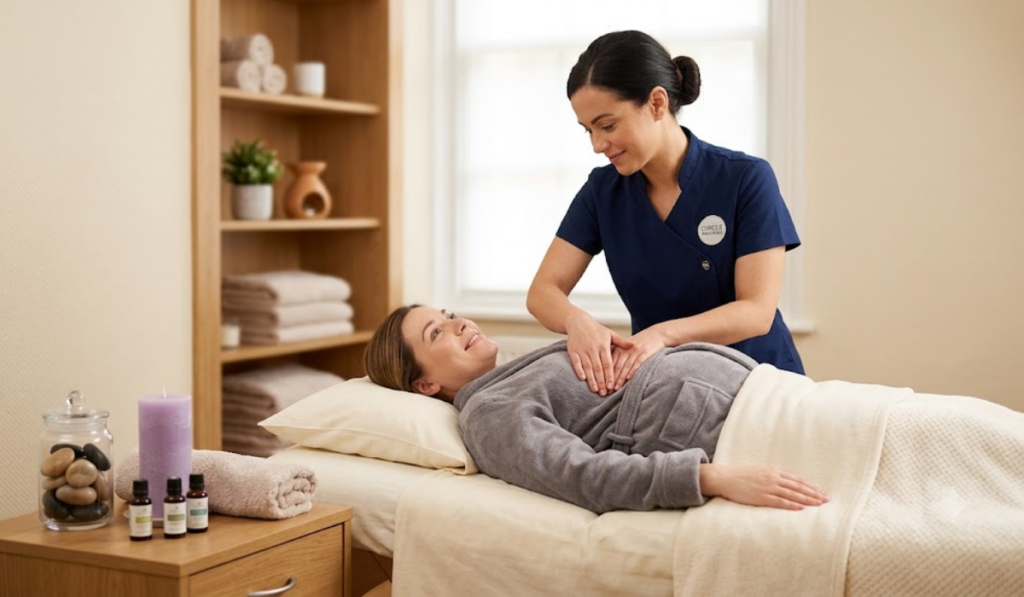
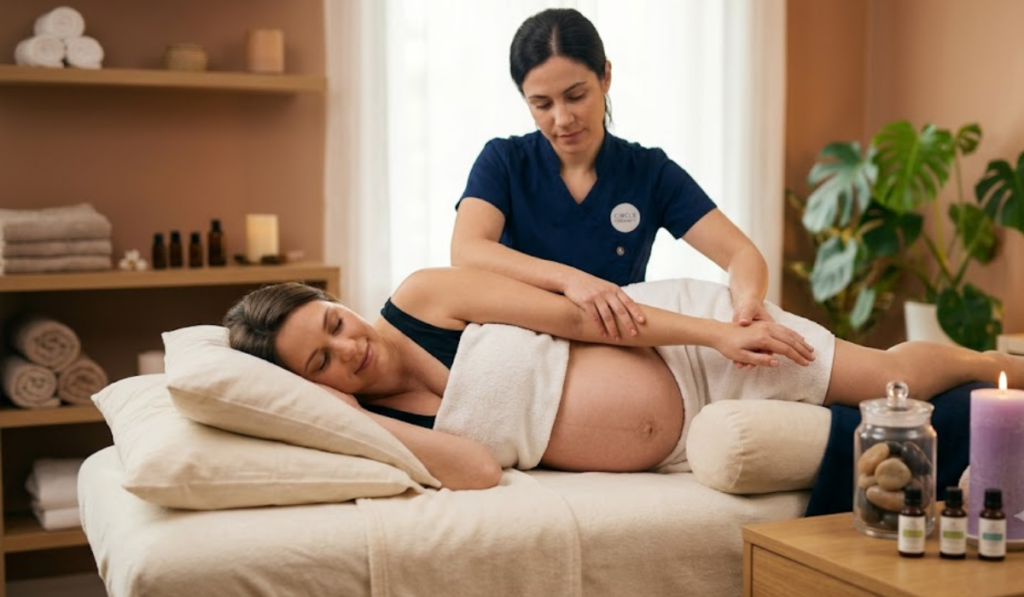
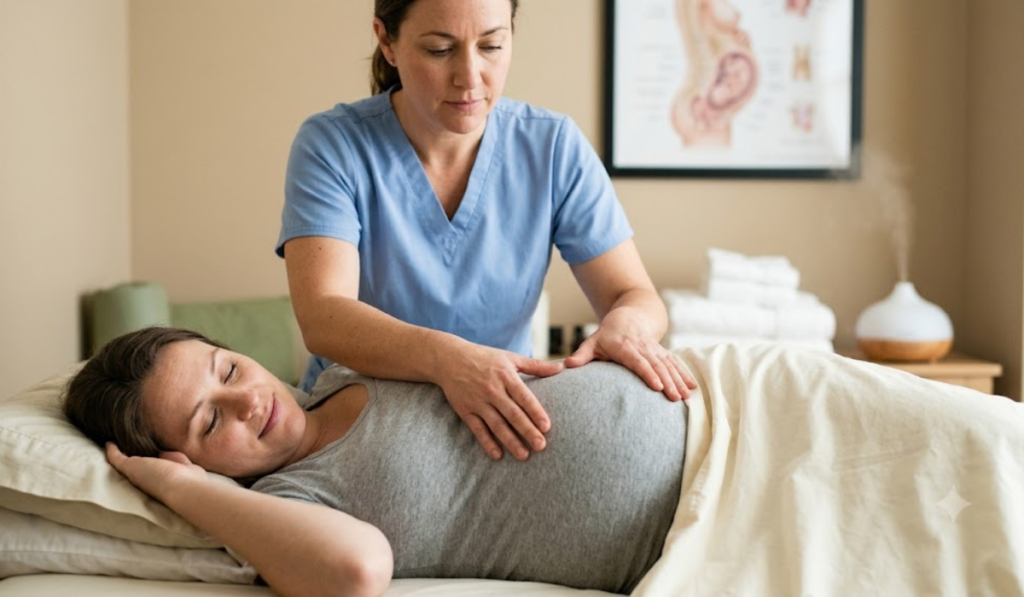
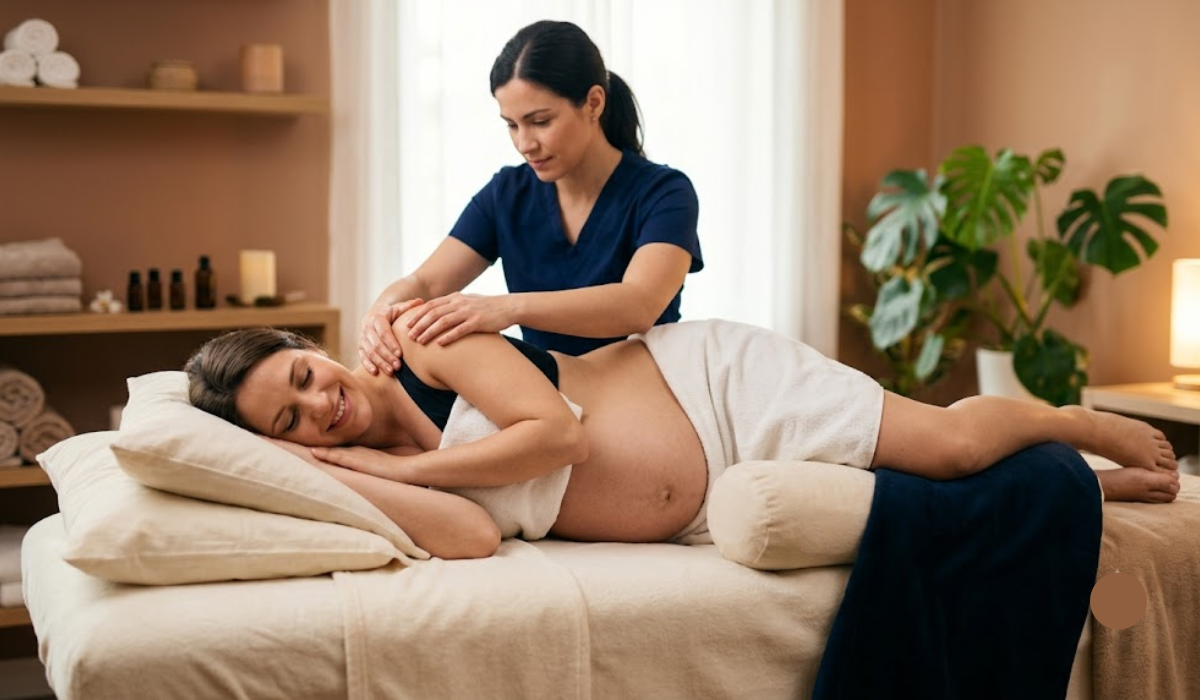
For most healthy pregnancies, gentle massage from a properly trained therapist can be performed safely with appropriate screening and positioning. The American College of Obstetricians and Gynecologists recommends side-lying as a comfortable position for pregnancy massage and advises telling the therapist about the pregnancy, even before it is visibly apparent. (acog.org)

Editorial and Commercial Disclosure

Circle Wellness provides paid prenatal and medical massage services in Melville, New York.

This article is educational. It does not determine whether massage is appropriate for an individual pregnancy and should not replace guidance from an OB-GYN, midwife, maternal-fetal medicine specialist, or other qualified healthcare professional.

Table of Contents

  1. Is prenatal massage safe?
  2. The real meaning of “areas to avoid”
  3. Areas that should not be massaged
  4. Areas that require modified pressure
  5. Pregnancy massage positioning
  6. Are the ankles and feet dangerous?
  7. Is abdominal massage safe?
  8. Is first-trimester massage safe?
  9. When to postpone the entire massage
  10. Conditions requiring medical clearance
  11. Safe areas and techniques
  12. Therapist screening checklist
  13. Partner massage during pregnancy
  14. Prenatal massage at Circle Wellness
  15. Frequently asked questions

Is Prenatal Massage Safe During Pregnancy?

For most people with healthy, uncomplicated pregnancies, prenatal massage appears to be reasonably safe when performed by a trained therapist using appropriate positioning and technique.

A systematic review of 12 randomized trials found that massage during pregnancy was associated with possible improvements in stress, anxiety, back pain, and leg discomfort. Reported adverse effects were generally minor and temporary.

However, the review had important limitations:

  • Participants were at least 12 weeks pregnant when the studies began.
  • Many studies excluded people with complicated or high-risk pregnancies.
  • Several studies did not fully report pre-existing medical conditions.
  • The research did not establish that every massage technique, pressure level, or body position is safe.
  • Evidence involving uncomplicated pregnancies should not automatically be applied to high-risk pregnancies.

(pubmed.ncbi.nlm.nih.gov)

Massage should therefore be described as a comfort-focused option—not as a treatment that prevents complications, guarantees better birth outcomes, or replaces prenatal medical care.

For a broader safety overview, read Circle Wellness’s guide: Is Prenatal Massage Safe During Pregnancy?.

What Does “Do Not Massage This Area” Really Mean?

Prenatal massage safety is better understood through three categories.

CategoryWhat it meansExamples
Stop and referDo not massage the area or continue the session until the patient has received appropriate medical assessmentPossible blood clot, heavy bleeding, chest pain, severe headache, leaking fluid
Avoid the areaThe local tissue should not receive massageOpen wound, skin infection, acute injury, known clot, inflamed vein
Modify the techniqueThe area may be treated gently, but pressure, position, duration, or technique must changeAbdomen, legs, lower back, swollen feet, sensitive breasts

A properly trained therapist does not follow a simplistic “never touch these five points” chart.

The therapist continuously considers:

  • What symptoms are present?
  • Are the symptoms normal for pregnancy?
  • Is one side different from the other?
  • Is the area tender, warm, red, or swollen?
  • Is the pressure comfortable?
  • Has the obstetric provider restricted activity or massage?
  • Is the patient becoming dizzy, nauseated, short of breath, or uncomfortable?
  • Is the massage within the therapist’s legal scope and training?

Areas That Should Not Be Massaged During Pregnancy

This is the most important area to avoid.

Pregnancy increases the risk of venous thromboembolism, which includes deep vein thrombosis and pulmonary embolism. The CDC states that pregnancy increases blood-clot risk approximately fivefold. The risk also remains elevated after delivery. (cdc.gov)

Possible deep vein thrombosis symptoms include:

  • Swelling in one leg or arm
  • Calf pain or tenderness
  • Warmth
  • Redness or discoloration
  • A feeling of tightness or heaviness
  • One limb looking noticeably different from the other

The therapist should not:

  • Knead the painful area
  • Perform deep calf pressure
  • Attempt lymphatic drainage over it
  • Apply percussion or vigorous friction
  • Try to “work out” the swelling
  • Continue the session as though it were normal muscle soreness

The session should be stopped and the patient advised to contact an appropriate healthcare professional promptly.

Difficulty breathing, chest pain, coughing blood, fainting, or a fast or irregular heartbeat may indicate a pulmonary embolism and require immediate emergency care. (cdc.gov)

Therapist rule

One-sided swelling, warmth, redness, or unexplained calf pain is not a tight-muscle problem until a clot has been ruled out.


Massage should not be performed over a diagnosed:

  • Deep vein thrombosis
  • Superficial thrombophlebitis
  • Inflamed vein
  • Area restricted by the treating clinician

The patient’s pregnancy-care and clot-management teams should determine whether massage elsewhere is appropriate.

A therapist should never assume that anticoagulant treatment makes deep pressure safe. Blood-thinning medication may also increase bruising risk.

Varicose veins are common during pregnancy.

A therapist may be able to work around uncomplicated varicose veins with gentle techniques, but should avoid:

  • Deep pressure directly over the vein
  • Aggressive stripping
  • Intense friction
  • Percussion
  • Painful compression

Do not treat a prominent vein as a muscle knot.

If the vein is:

  • Red
  • Hot
  • Hard
  • Painful
  • Suddenly more swollen

the area needs medical evaluation before massage.


Do not massage directly over:

  • Open cuts
  • Burns
  • Draining wounds
  • Cellulitis
  • Fungal infections
  • Active herpes lesions
  • Unexplained blistering
  • Severe dermatitis
  • A contagious rash
  • An infected insect bite

Massage may irritate the tissue, spread infection, or contaminate equipment.

The therapist should also consider whether a widespread infection, fever, or contagious illness means the entire appointment should be postponed.


Avoid direct massage over:

  • A recent abdominal incision
  • A recently placed medical device
  • A biopsy site
  • A wound that has not fully closed
  • An area restricted by the surgeon or obstetric provider

This is particularly relevant after pregnancy-related procedures or during the postpartum period.

Scar work should begin only when the tissue has healed and the treating clinician has indicated that it is appropriate.

Do not massage an area with:

  • Recent major trauma
  • Suspected fracture
  • Severe bruising
  • Significant joint instability
  • Sudden loss of movement
  • Deformity
  • Severe pain after a fall

Pregnancy-related joint laxity can alter stability, but it does not mean every painful joint should be massaged.

An acute injury may require imaging or medical assessment.

Massage should not be used to “test” severe or unexplained symptoms.

Stop and refer when a patient reports:

  • Sudden severe back pain
  • New leg weakness
  • Numbness in the groin or saddle region
  • Loss of bladder or bowel control
  • New difficulty walking
  • Severe abdominal or pelvic pain
  • Pain accompanied by fever
  • Rhythmic back pain or tightening that may represent contractions

Pregnancy discomfort is common, but new neurological or severe symptoms require diagnosis.

The patient’s provider may advise avoiding an area because of:

  • A placental condition
  • Recent bleeding
  • A surgical procedure
  • A vascular concern
  • An injury
  • A pregnancy complication
  • A medical device
  • A high-risk condition

The therapist should follow documented restrictions and seek clarification when instructions are unclear.

Areas That Require Modified Pressure Rather Than a Complete Ban

Deep, forceful, or painful abdominal massage is not appropriate during routine prenatal massage.

Avoid:

  • Deep compression
  • Aggressive kneading
  • Strong friction
  • Forceful stretching
  • Deep psoas or internal abdominal work
  • Pressure that causes guarding, pain, nausea, or contractions

However, it is inaccurate to say that the pregnant abdomen can never be touched.

Gentle contact may include:

  • Applying lotion
  • Light, comforting strokes
  • Supported hand placement
  • Gentle skin-level touch requested by the patient

Any abdominal contact should be:

  • Optional
  • Clearly explained
  • Within the therapist’s prenatal training
  • Performed with informed consent
  • Immediately stopped if uncomfortable

No therapist should claim that routine abdominal massage can reposition the fetus, manipulate the placenta, prevent stretch marks, or treat an obstetric complication.

The legs are not automatically off-limits.

Gentle leg massage may feel comforting in a healthy pregnancy when there are no blood-clot warning signs or medical restrictions.

Therapists should use additional caution because pregnancy raises clot risk.

Avoid:

  • Painful deep calf work
  • Aggressive pressure over varicose veins
  • Deep work over unexplained swelling
  • Treating unilateral calf pain as muscle tightness
  • Forceful techniques in a patient with known clotting concerns unless specifically cleared

The safest approach is to screen first and modify pressure according to the patient’s health history and tissue response.

Mild, symmetrical ankle or foot swelling is common later in pregnancy.

Gentle massage may be appropriate when:

  • Both sides are similarly affected
  • There is no redness or unusual warmth
  • There is no severe pain
  • There are no other warning signs
  • The patient’s provider has not restricted treatment

Massage should stop if swelling is:

  • Sudden
  • Severe
  • Mostly on one side
  • Accompanied by calf pain
  • Associated with headache or vision changes
  • Associated with swelling of the hands or face

Sudden swelling of the face or hands can be a warning sign of preeclampsia and should be reported to the obstetric provider. (acog.org)

The lower back is not a forbidden prenatal massage area.

It is one of the most common areas patients want treated.

A therapist may work gently on:

  • Lumbar muscles
  • Gluteal muscles
  • Hip rotators
  • Sacral region
  • Supporting muscles around the pelvis

The patient should be comfortably positioned, and pressure should not be painful.

Stop if back pain is accompanied by:

  • Vaginal bleeding
  • Leaking fluid
  • Regular contractions
  • Fever
  • Severe abdominal pain
  • New weakness or numbness
  • Urinary symptoms
  • Reduced fetal movement

Circle Wellness discusses pregnancy-related back discomfort in Prenatal Massage for Pregnancy Back Pain.

Routine prenatal massage generally does not require breast or nipple massage.

Nipple stimulation can increase oxytocin and has been studied as a possible method of encouraging labor. Evidence remains limited, and its safety has not been adequately established for high-risk pregnancies. (cochrane.org)

Therefore:

  • Do not include nipple stimulation in an ordinary prenatal massage.
  • Do not use breast stimulation to attempt labor induction without the obstetric provider’s guidance.
  • Obtain specific informed consent for any clinically appropriate breast or chest work.
  • Respect professional boundaries, draping rules, training, and state law.
  • Avoid inflamed, infected, painful, or suspicious breast tissue.

Pregnancy Massage Positions to Avoid or Modify

After approximately 20 weeks, lying flat on the back can allow the uterus to compress major blood vessels in some pregnant patients.

This may reduce venous return and cause:

  • Dizziness
  • Nausea
  • Sweating
  • Lightheadedness
  • Shortness of breath
  • A feeling of needing to move immediately

ACOG notes that prolonged supine positioning after 20 weeks can reduce venous return because of aortocaval compression. (acog.org)

Safer options include:

  • Side-lying with pillows
  • Semi-reclined positioning
  • Seated massage
  • A supported tilt rather than completely flat positioning

A brief position change is different from lying flat for an entire session. The therapist should monitor symptoms and reposition immediately if the patient becomes uncomfortable.

A growing abdomen should not be compressed against a standard flat massage table.

ACOG notes that some specially designed tables have an abdominal cutout, but side-lying is commonly preferred because it can provide easier support and adjustment. (acog.org)

The patient should never be forced to remain in a position that causes:

  • Abdominal pressure
  • Low-back strain
  • Breast discomfort
  • Shortness of breath
  • Pelvic pressure
  • Dizziness

Circle Wellness explains its positioning process in What to Expect at Your First Prenatal Massage.

Are the Ankles, Feet, Wrists, and Hands Dangerous?

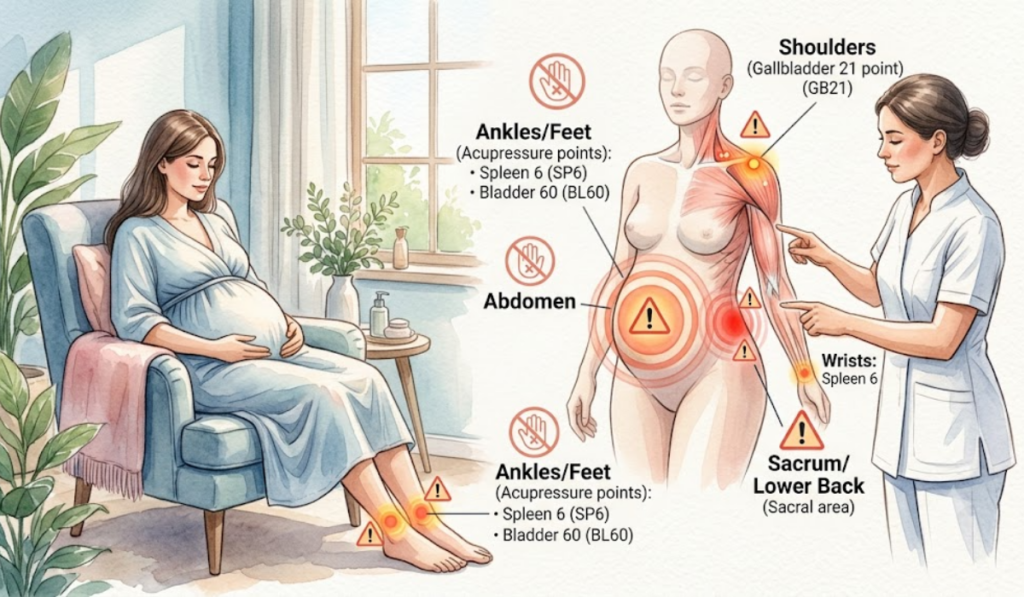
A common pregnancy-massage myth says that touching certain points on the ankles, hands, or wrists can immediately trigger labor.

That claim is too absolute.

Acupuncture and acupressure have been studied for cervical ripening and labor induction, but the research is inconsistent. A Cochrane review found no clear benefit from acupressure for the induction outcomes it examined and concluded that more safety and effectiveness research was needed. (cochrane.org)

This means:

  • Ordinary gentle foot massage has not been shown to reliably start labor.
  • The ankles are not universally forbidden.
  • The hands and wrists are not universally forbidden.
  • Light, comfortable massage is different from prolonged, focused acupressure intended to stimulate labor.
  • Techniques specifically used for labor preparation should be reserved for appropriate gestational timing and coordinated with the obstetric provider.
Safer therapist wording

Do not tell patients:

“Touching this ankle point can cause miscarriage.”

Say:

“Gentle foot and ankle massage is generally different from sustained acupressure used with the intention of influencing labor. We avoid labor-focused techniques unless they are appropriate for your stage of pregnancy and approved by your provider.”

Is Abdominal Massage Dangerous During Pregnancy?

Not every touch to the abdomen is dangerous.

The distinction is between:

  • Gentle, consented surface contact
  • Deep or forceful therapeutic manipulation

A routine therapist should not use the pregnant abdomen for:

  • Deep tissue work
  • Forceful trigger-point pressure
  • Internal organ manipulation
  • Aggressive stretching
  • Attempts to move the fetus
  • Attempts to treat the placenta
  • Attempts to initiate labor

A trained prenatal therapist may use gentle contact when the patient requests it and has no medical restriction.

The patient’s comfort controls the session.

Any abdominal pain, tightening, contractions, bleeding, or leaking fluid requires the session to stop and the patient to contact the pregnancy-care provider.

Is Massage Unsafe During the First Trimester?

Massage is not universally prohibited during the first trimester.

There is no good evidence that a properly performed gentle massage causes miscarriage.

Miscarriage is more common in early pregnancy for reasons unrelated to massage. The fact that miscarriages occur more often during the first trimester does not prove that massage causes them.

However, first-trimester research is limited. The randomized trials included in one systematic review began at 12 weeks or later, so the absence of reported harm in those studies cannot answer every first-trimester safety question. (pubmed.ncbi.nlm.nih.gov)

Some therapists or businesses choose not to provide massage during the first trimester because of:

  • Internal risk-management policies
  • Limited research
  • Nausea
  • Fatigue
  • Dizziness
  • Breast tenderness
  • Patient preference

That is a clinic policy—not proof that first-trimester massage is inherently dangerous.

A pregnant patient should speak with the obstetric provider when:

  • The pregnancy is high risk
  • There has been bleeding
  • There is severe pain
  • There is a history of recurrent pregnancy loss
  • The provider has placed activity restrictions
  • The patient is unsure whether massage is appropriate

When to Postpone the Entire Prenatal Massage

Massage should not begin—or should stop immediately—when the patient has an urgent maternal warning sign.

The CDC recommends prompt medical care for symptoms including:

  • A severe headache that will not go away
  • Dizziness or fainting
  • Vision changes
  • Fever of 100.4°F or higher
  • Extreme swelling of the hands or face
  • Trouble breathing
  • Chest pain or a fast-beating heart
  • Severe nausea and vomiting
  • Severe abdominal pain
  • Vaginal bleeding
  • Leaking fluid
  • Reduced or stopped fetal movement
  • Severe swelling, redness, or pain in one leg or arm

(cdc.gov)

A massage therapist should not attempt to diagnose these conditions.

The therapist’s role is to:

  1. Recognize that the symptom is outside routine massage care.
  2. Stop or postpone treatment.
  3. Advise the patient to contact the appropriate medical professional.
  4. Call emergency services when symptoms suggest an emergency.
Stop the Session Immediately If the Patient Develops
  • Faintness
  • Chest discomfort
  • Difficulty breathing
  • Sudden severe pain
  • Visual disturbance
  • Regular painful contractions
  • Vaginal bleeding
  • Leaking fluid
  • New neurological symptoms
  • Signs of an allergic reaction
  • A strong sense that something is wrong

Safe Areas Commonly Treated During Prenatal Massage

What Techniques Are Commonly Modified During Pregnancy?

Stop the session and refer for medical care when there is:

  • Possible blood clot
  • Chest pain
  • Trouble breathing
  • Severe headache
  • Vision change
  • Vaginal bleeding
  • Leaking fluid
  • Severe abdominal pain
  • Reduced fetal movement
  • Regular preterm contractions
  • Fainting
  • Fever
  • New neurological symptoms

Modify treatment when there is:

  • Later-stage pregnancy
  • Mild symmetrical swelling
  • Varicose veins
  • Tender abdominal tissue
  • Joint laxity
  • Position-related dizziness
  • Breast tenderness
  • Bruising tendency
  • Provider-imposed pressure or positioning restrictions

Proceed when:

  • The pregnancy is stable
  • There are no warning signs
  • The patient can be positioned comfortably
  • The therapist has appropriate prenatal training
  • The patient has consented
  • The technique is within scope
  • Pressure remains comfortable
  • The therapist continues to monitor symptoms

Can a Partner Give a Pregnancy Massage?

Gentle partner massage may be comfortable for many healthy pregnancies.

Safer areas commonly include:

  • Shoulders
  • Upper back
  • Hands
  • Forearms
  • Scalp
  • Feet, when there are no clot symptoms
  • Lower back, using comfortable pressure
  • Hips and gluteal muscles, within the pregnant person’s comfort

Partners should avoid:

  • Deep abdominal pressure
  • Painful calf work
  • Direct pressure over varicose veins
  • Any area with swelling, redness, warmth, or unexplained tenderness
  • Nipple stimulation intended to start labor
  • Forceful stretching
  • Attempting to manipulate the pelvis or move the baby

Stop immediately if the pregnant person experiences pain, dizziness, shortness of breath, contractions, bleeding, or leaking fluid.

Prenatal Massage Myths

MythMore accurate explanation
Massage always causes miscarriage in the first trimester.There is no evidence that properly performed gentle massage causes miscarriage. Research during very early pregnancy remains limited.
The ankles can never be touched.Gentle ankle and foot massage is not proven to start labor. Sustained labor-focused acupressure is a separate technique.
The abdomen must never be touched.Deep abdominal work is inappropriate, but gentle, optional contact may be acceptable for an uncomplicated pregnancy.
Every pregnant person needs extremely light pressure.Pressure should be individualized. Painful, aggressive, or high-risk-area pressure should be avoided.
Lying on the back is immediately dangerous.Prolonged flat positioning later in pregnancy may cause symptoms in some patients. Side-lying or semi-reclined support is generally preferred.
Massage removes pregnancy swelling.Massage may feel soothing for mild swelling, but sudden, severe, or one-sided swelling requires medical assessment.
Prenatal massage can safely induce labor.Massage should not be offered as a labor-induction treatment without obstetric guidance.
A spa therapist and prenatal-trained therapist provide the same service.Prenatal training includes screening, positioning, pressure modification, and recognition of warning signs.
More pressure creates more relief.Painful or aggressive work can worsen symptoms and is not necessary for an effective session.

What Evidence Supports Prenatal Massage Benefits?

Research suggests that prenatal massage may help some patients with:

  • Stress
  • Anxiety
  • Lower-back discomfort
  • Leg discomfort
  • General relaxation

However, results should be presented cautiously.

The 2021 systematic review found possible benefits but noted uncertainty, limited reporting, and frequent exclusion of complicated pregnancies. It does not establish that massage:

  • Prevents preterm birth
  • Guarantees a shorter labor
  • Improves fetal growth
  • Treats preeclampsia
  • Corrects fetal position
  • Prevents pregnancy complications
  • Replaces physical therapy or obstetric care

(pubmed.ncbi.nlm.nih.gov)

The most defensible goal is comfort and relaxation—not a promised medical or birth outcome.

home 2 svg 4

Not Sure Whether Prenatal Massage Is Appropriate?

Pregnancy discomfort can be normal, but pain, swelling, headaches, dizziness, and shortness of breath can also require medical evaluation.

Prenatal Massage at Circle Wellness in Melville

Circle Wellness provides prenatal massage through licensed, pregnancy-trained massage professionals at its Melville location.

A prenatal appointment may include:

  1. Review of trimester and due date
  2. Discussion of current symptoms
  3. Screening for pregnancy complications and restrictions
  4. Identification of areas the patient does not want treated
  5. Side-lying or semi-reclined positioning
  6. Pillow and bolster support
  7. Pressure adjustments throughout the session
  8. Immediate repositioning when discomfort occurs
  9. Guidance about symptoms that should be discussed with the pregnancy-care provider

Circle Wellness also provides related education about:

Circle Wellness is located at:

Melville Corporate Plaza
25 Melville Park Road, Suite 200 B
Melville, NY 11747

The clinic is near Route 110, Maxess Road, and Long Island Expressway Exit 49. Its published contact numbers are (631) 888-5957 and (888) 293-5577. (circlewellnessmd.com)

home 2 svg 4

Book a Pregnancy-Safe Massage Consultation

Prenatal massage is intended to support comfort and relaxation. It is not a treatment for pregnancy complications and should never delay obstetric or emergency care.

FAQs

336

Do not massage directly over:

  • A suspected or diagnosed blood clot
  • A leg or arm with one-sided redness, warmth, swelling, or unexplained tenderness
  • An open wound
  • A skin infection
  • A recent unhealed incision
  • A suspected fracture
  • An area with severe unexplained pain
  • An area restricted by the patient’s provider

Deep abdominal pressure and painful calf work should also be avoided.

Gentle foot massage is generally not considered a proven cause of labor.Do not massage a foot or leg when there is one-sided swelling, calf pain, redness, unusual warmth, or a suspected clot.

Sustained acupressure specifically intended to encourage labor should not be used before term or without obstetric guidance.

There is not strong evidence that ordinary ankle massage reliably induces labor.

Acupressure used intentionally for labor preparation is a different practice. Research on induction is inconsistent, and these techniques should be coordinated with the pregnancy-care provider.

Yes, the lower back is commonly treated during prenatal massage.

The patient should be positioned comfortably, and pressure should not cause pain. Severe back pain accompanied by bleeding, contractions, fever, leaking fluid, weakness, or numbness requires medical assessment.

Deep or forceful abdominal work should not be performed during a routine prenatal massage.

Gentle, optional surface contact may be acceptable when the pregnancy is uncomplicated, the patient consents, and the therapist has appropriate training.

“Deep tissue” is too broad to answer with one rule.

Pressure should be adapted according to the body area, patient comfort, medical history, clot risk, tissue condition, and provider restrictions.

Painful deep calf pressure, aggressive abdominal work, and work over varicose or inflamed veins should be avoided.

Not automatically.

There is no strong evidence that gentle massage causes miscarriage. However, early-pregnancy research is limited, and some clinics have policies that require provider clearance or delay treatment.

Brief supported positioning may be tolerated, but prolonged flat-on-the-back positioning later in pregnancy can cause symptoms in some patients.

Side-lying, semi-reclined, or supported-tilt positioning is generally preferred.

Ordinary gentle prenatal massage has not been shown to reliably start labor.

Nipple stimulation and focused labor-induction acupressure are different techniques and should not be used casually, particularly before term or during a high-risk pregnancy.

Gentle massage may feel comforting for mild, symmetrical swelling.

Do not massage sudden, severe, painful, warm, red, or one-sided swelling. Contact the obstetric provider.

Possibly, but the therapist should avoid deep pressure directly over prominent, painful, red, warm, or hardened veins.

A suspected inflamed vein requires medical assessment.

Postpone massage and seek medical advice when there is:

  • Vaginal bleeding
  • Leaking fluid
  • Regular or preterm contractions
  • Severe headache
  • Vision changes
  • Chest pain
  • Trouble breathing
  • Fever
  • Severe abdominal pain
  • Reduced fetal movement
  • Severe vomiting
  • One-sided leg swelling or pain
  • Any urgent maternal warning sign

Not every healthy pregnancy requires written permission.

Provider clearance is advisable when the pregnancy is high risk, symptoms are concerning, a complication is present, or the therapist needs clarification about restrictions.

Yes. Circle Wellness’s website lists certified prenatal massage among its services in Melville, New York. Appointment selection is available through the clinic’s service-booking page. (circlewellnessmd.com)

Medical Disclaimer

This article provides general educational information and is not a substitute for individualized medical advice.

Pregnancy conditions can change quickly. Contact an OB-GYN, midwife, maternal-fetal medicine specialist, or emergency service when warning signs are present.

Massage therapists should follow applicable state law, professional scope, training standards, informed-consent requirements, and the patient’s documented medical restrictions.

Do not use massage to delay evaluation of bleeding, leaking fluid, contractions, severe headache, vision changes, chest pain, breathing difficulty, severe swelling, reduced fetal movement, or suspected blood-clot symptoms.

Legal Disclaimer

The information provided on this blog and website is for informational and educational purposes only and is not intended as a substitute for professional medical advice, diagnosis, or treatment. Always seek the guidance of your physician or another qualified health provider with any questions you may have regarding a medical condition, diagnosis, or treatment plan. Do not disregard or delay professional medical advice because of information you have read on this website.

The content presented may include discussions of wellness therapies, dietary supplements, compounded medications, and other integrative or alternative treatments that are not evaluated or approved by the U.S. Food and Drug Administration (FDA). These services and products are not intended to diagnose, treat, cure, or prevent any disease.

The content is provided “as is,“ without warranties of any kind, either express or implied. While we strive to ensure accuracy, we make no guarantees regarding the completeness, timeliness, or accuracy of the information presented. The website and its authors disclaim any liability for errors, omissions, or outcomes related to the use of the information provided.

Reference to any specific tests, products, procedures, healthcare professionals, or opinions is not an endorsement or recommendation unless explicitly stated. Links to external websites are provided for convenience and do not constitute an endorsement or guarantee of the content contained therein.

Your use of this website constitutes your acceptance of this disclaimer and any future modifications. If you do not agree, please do not use the site.

This disclaimer shall be governed by and construed in accordance with the laws of the State of New York, without regard to conflict of law principles

Leave a Reply

Your email address will not be published. Required fields are marked *